What’s the Difference Between Regular SEO and AI Search Optimization?
Search behavior is changing. Fast. Google still handles most search queries. But a growing share of research, comparisons, and buying decisions now start inside AI tools like ChatGPT, Gemini, and Perplexity.
Users used to type fragmented keywords. Now they ask full questions. And instead of a list of blue links, they get a direct answer.
This shift is why so many marketers are now asking about SEO vs AI SEO. Gartner has predicted that traditional search engine volume will decline as generative AI tools take on more of the queries people used to run through Google. So the question isn’t whether things are changing. It’s how.
Here’s the honest answer. Traditional SEO isn’t going away. But it’s no longer the whole picture. AI search engines evaluate content differently. And businesses that only optimize for classic rankings are leaving visibility on the table.
This article breaks down exactly how traditional SEO and AI Search Optimization differ. We’ll cover how each system evaluates content. And we’ll look at what agencies and businesses need to do to stay visible in both.
What is Traditional SEO?
Traditional SEO is built around one goal. Help search engines like Google crawl, index, and rank web pages. It’s a system based on matching queries to pages. Then it ranks those pages using relevance and authority signals.
A few core components drive this system.
Keywords. Search engines match the words in a query to the words on a page. Keyword research still matters. It tells you what people search for and how they phrase their questions.
Backlinks: Links from other websites act as a vote of confidence. Google has confirmed for years that backlinks remain one of its top ranking factors. They signal that other sites trust your content enough to reference it.
Technical SEO: This covers crawlability, site speed, mobile usability, structured data, and indexation. If search engines can’t crawl or render your site properly, nothing else matters.
On-page SEO: Title tags, header structure, internal linking, and content formatting all help search engines understand what a page is about. They also help categorize that page correctly.
Traditional SEO is page-centric. It ranks individual URLs against a query. The goal is simple: appear in the top positions of a search engine results page (SERP). This model has worked for over two decades. It still drives most organic traffic for most websites today.
What is AI Search Optimization?
AI Search Optimization is different. It’s the practice of optimizing content so it gets surfaced, cited, or summarized inside AI-generated answers. Think AI Overviews in Google, or conversational tools like ChatGPT, Gemini, and Perplexity. Traditional SEO matches keywords to pages. AI systems don’t work that way. Instead, they understand meaning. They break content down into concepts, relationships, and entities. Then they use that understanding to generate a direct answer to a user’s question.
This is often called semantic search or context-based ranking. Why? Because the system evaluates what a piece of content means, not just what words it contains.
A few concepts define how AI search engines operate.
Semantic understanding: AI models interpret the meaning behind a query. That includes intent, context, and related concepts. It’s not just exact phrase matching.
Entity-based indexing: AI systems identify people, brands, products, places, and topics as distinct entities. Then they connect them to related information across the web. This is why entity SEO has become such an important part of modern content strategy.
Generative responses: Instead of returning a list of links, AI search tools generate a direct written answer. Often, that answer pulls from multiple sources at once.

This is the foundation of Generative Engine Optimization, or GEO. We’ll cover GEO in more detail further down. For now, here’s the core distinction to remember. Traditional SEO ranks pages. AI Search Optimization influences whether your content gets used to construct an answer.
Key Differences Between SEO and AI Search Optimization
So what does the difference between SEO and AI SEO actually come down to? It’s how each system processes information. And it’s what each system produces as an outcome. Here’s a breakdown of the core distinctions.
Ranking System (Keywords vs Context)
Traditional SEO ranks pages based on keyword relevance and authority signals. AI Search Optimization works differently. It evaluates context, meaning, and how well content answers a specific question. Exact keyword match matters less.
Content Understanding (Pages vs Meaning)
Search engines evaluate individual pages as standalone units. Each page competes for a ranking position on its own. AI systems take a broader view. They evaluate meaning across a wider set of sources. Then they synthesize that meaning into a single response.
Backlinks vs Authority Signals
Backlinks remain important for traditional rankings. That hasn’t changed. But AI systems weigh authority differently too. They also factor in brand mentions, citations, structured data, and consistency of information across the web. And they can do this even without a direct link.
SERPs vs AI Answers
Traditional SEO success is measured by SERP position. Simple as that. AI Search Optimization success looks different. It’s measured by whether your content gets cited, summarized, or referenced inside a generated answer.
Keyword SEO vs Entity SEO
Traditional SEO organizes content around keywords and search volume. AI Search Optimization takes a different approach. It organizes content around entities. These are the specific concepts, brands, and topics that AI systems use to build a knowledge structure.
Click-Based Traffic vs Answer-Based Visibility
Traditional SEO drives visitors to click through to your website. That’s the whole point. AI Search Optimization often works differently. It delivers visibility without a click. The user gets their answer directly inside the AI interface.
| Factor | Traditional SEO | AI Search Optimization (AISO) |
|---|---|---|
| Ranking Basis | Keywords and backlinks | Context, semantic meaning, and user intent |
| Content Unit | Individual web pages | Synthesized information across multiple sources |
| Authority Signals | Backlinks and domain authority | Brand mentions, citations, structured data, and topical authority |
| Output | List of ranked search results (SERP) | AI-generated answers, summaries, or direct responses |
| Organizing Structure | Keyword-focused content clusters | Entity-based topics and semantic relationships |
| Traffic Outcome | Users click through to the website | Greater visibility in AI-generated responses without guaranteed website clicks |
How AI Search is Changing SEO
The rise of zero-click search is one of the clearest signs that search behavior has changed. SparkToro’s research tracked US zero-click searches at roughly 60% in 2024. That share has kept climbing as AI-generated answers become more common in Google’s results.
Here’s more proof. Pew Research Center found that users click on a traditional search result just 8% of the time when an AI summary appears, compared to 15% when it doesn’t. Users are getting their answer right in the search results. And AI Overviews only accelerate that trend.
So what does this mean for SEO strategy? The goal is shifting. It’s moving from ranking pages to satisfying search intent as directly as possible. Google has emphasized user intent as a ranking priority for years. AI search just makes intent even more central. If your content doesn’t clearly answer a question, it’s less likely to get pulled into a generated response.
Conversational search is reshaping things too. Users used to type “best CRM software.” Now they ask, “What’s the best CRM for a 20-person sales team that already uses HubSpot?” That level of specificity requires content that goes deeper than a generic keyword-targeted page.
This is where topical authority becomes critical. Sites that comprehensively cover a subject area are better positioned as trusted sources. That means strong internal linking. It means clear entity relationships. And it applies to both traditional rankings and AI-generated answers. A single optimized page can’t compete with a site that demonstrates depth across an entire topic.
Marketers are already responding to this shift. In a HubSpot survey of US-based SEO professionals, 73% either strongly or somewhat agreed that AI tools are becoming an important part of their company’s SEO strategy. That’s a strong signal. AI search has moved from an emerging trend to a standard part of the SEO conversation.
What is Generative Engine Optimization (GEO)?
We structure and optimize your content so AI platforms like ChatGPT, Gemini, and Perplexity cite, summarize, and recommend your brand, turning generative search into a real visibility channel instead of a traffic leak.
How GEO Works
GEO focuses on clarity, structure, and factual accuracy. AI models favor content that clearly states facts. They favor content that defines terms and answers specific questions directly. Organization matters too. Clear headings, direct answers near the top of a section, and well-structured data like tables or lists all help.
Why GEO Matters
More users are turning to AI tools for research and recommendations. Because of this, brands that don’t show up in generative answers risk losing visibility. That’s true even if they still rank well in traditional search. GEO is how businesses stay relevant as search behavior keeps shifting toward conversational, answer-based experiences.
Relationship Between SEO and GEO
GEO doesn’t replace SEO. It builds on it. Strong technical SEO, quality backlinks, and well-structured content are still foundational. GEO adds a layer on top. It focuses on semantic clarity and answer-readiness. That means the same content strategy can serve both traditional rankings and AI-generated visibility.
This relationship shows up clearly in the data. A study from Originality.ai found that 48% of citations inside AI Overviews overlap with pages ranking in the top 100 organic results for the same query. In other words, close to half of what AI systems cite already has a foothold in traditional rankings. That’s a strong argument for treating SEO and GEO as one connected strategy, not two separate efforts.
How Businesses Should Optimize for Both SEO and AI Search
We build one content and technical strategy that strengthens organic rankings and AI-generated visibility together, so your business shows up whether the answer comes from a SERP or a chatbot.
Write Semantic Content- Focus on topics and concepts, not just keywords. Cover related subtopics thoroughly. This helps search engines and AI models understand the full context of your subject matter.
Build Topical Authority- Create clusters of related content around core topics. Connect them through internal linking. Once you do that, both traditional search engines and AI systems can recognize your site as a credible source on that subject.
Use Structured Data- Schema markup helps search engines and AI crawlers understand entities, relationships, and content types. It gives them a clearer picture. FAQ schema, article schema, and organization schema are all worth prioritizing.
Strengthen Brand Mentions- AI systems weigh brand mentions and citations as authority signals. That’s true even without a direct link. So consistent, accurate mentions of your brand across reputable sites help reinforce your credibility.
Optimize for Entities- Make sure your brand, products, and key concepts are clearly defined. Keep descriptions consistent across your website and third-party sources. This helps AI systems correctly identify and categorize your business.
Improve Content Depth- Shallow, surface-level content struggles in both traditional and AI search. Go deeper into subtopics. Include specific examples. Address the follow-up questions a reader is likely to have.
Create Answer-Focused Content- Structure content so it directly answers specific questions early. Then expand with supporting detail. This format works well for featured snippets, AI Overviews, and generative answers alike.
Why White Label SEO is Evolving
As the gap between traditional SEO and AI Search Optimization grows, agencies feel the pressure. They need to deliver both without doubling their internal workload. This is a big reason why white label marketing company partnerships have become more common. Building in-house expertise across technical SEO, entity optimization, structured data, and AI-ready content takes time. It takes specialized knowledge. And it takes ongoing investment.
White Label SEO services have evolved alongside this shift. It’s no longer just about outsourcing content writing or link building. Modern white label partners need to support AI SEO optimization. They need scalable reporting systems, automation, and analytics. And those systems need to account for both SERP rankings and AI-generated visibility. Agencies that rely on an outdated white label model risk falling behind on the very trends their clients are asking about.
How White Label Partner Helps Businesses
White Label Partner works behind the scenes. The goal is simple: help agencies and businesses deliver modern SEO without building every capability internally. That includes White Label SEO execution, AI Search Optimization strategy, technical SEO audits, and entity optimization. Each piece is designed to strengthen how brands appear across both traditional and AI-driven search.
The work covers keyword strategy and content optimization built for semantic relevance. It also includes ranking improvement systems that track performance across SERPs and generative answers. Marketing automation and scalable delivery processes make it possible for agencies to expand their SEO offering. And they can do it without expanding their internal team.
So how does an agency decide? Build these capabilities in-house, or work with an outsourcing SEO agencies model? Usually, it comes down to speed, cost, and consistency. A dependable SEO outsourcing partner lets agencies offer AI-ready SEO services under their own brand. Meanwhile, they can rely on established systems and expertise to execute the work.
Future of SEO in the AI Era
The Future of SEO points toward AI-first search experiences. Conversational interfaces and personalized results will play a bigger role in how people find information. Voice search keeps growing too. It favors content that answers questions directly and conversationally. That’s similar to how GEO-optimized content gets structured.
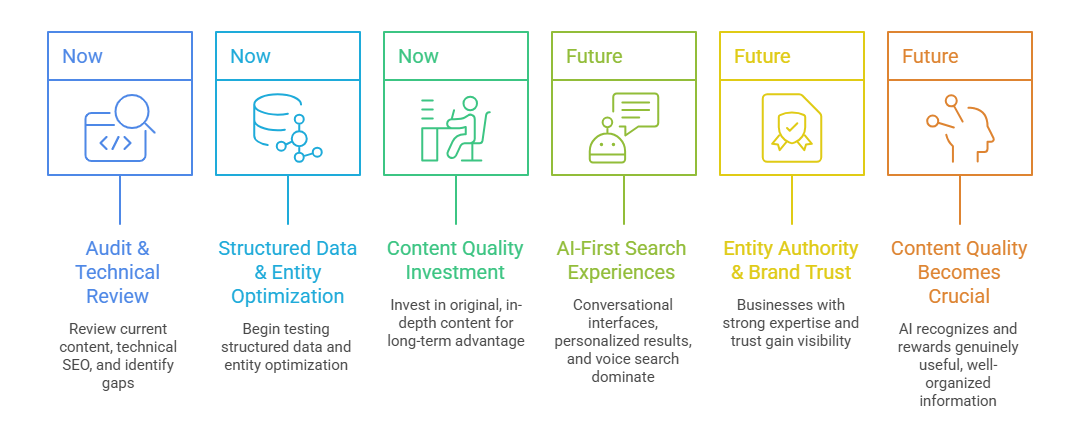
Entity authority and brand trust are becoming more central to visibility. As AI systems get better at identifying credible sources, businesses with consistent, well-documented expertise will have an advantage. Meanwhile, businesses relying purely on keyword tactics will fall behind.
Content quality is also getting harder to fake. AI models are trained to recognize genuinely useful, well-organized information. That means thin or duplicated content has less room to perform well. This applies to both traditional and AI search. Businesses that invest in original, in-depth content now are building an advantage that compounds over time.
So what should you actually do? Start with an audit. Review your current content for depth and accuracy. Check your technical SEO fundamentals. Then start testing structured data and entity optimization now. Waiting until AI search fully matures will leave less room to catch up.
It’s also worth reviewing your current strategy against common seo mistakes. Why? Because many of the same technical and content gaps quietly limit both traditional rankings and AI visibility.
Search Visibility Requires More Than Rankings
Traditional SEO and AI Search Optimization aren’t competing strategies. They’re complementary. Search visibility today depends on both SERP rankings and AI-generated answers. So businesses that only optimize for one side of this equation are missing a growing share of how people find information. White Label Partner helps agencies and businesses build scalable SEO, AI Search Optimization, and automation systems that keep pace with this shift. And they can do it without a full internal build-out. If you’re ready to strengthen your SEO and AI search strategy, request a quote today and see how a dedicated partner can support your growth.
Frequently Asked Questions


