
NDA & Data Security in White Label Partnerships: What Agencies Should Require
Asking a promising delivery partner to put confidentiality in writing can feel unnecessarily formal. You’re so keen to get moving, and so you don’t want the first conversation to sound distrustful. Still, your client’s information comes with responsibilities that enthusiasm can’t settle.
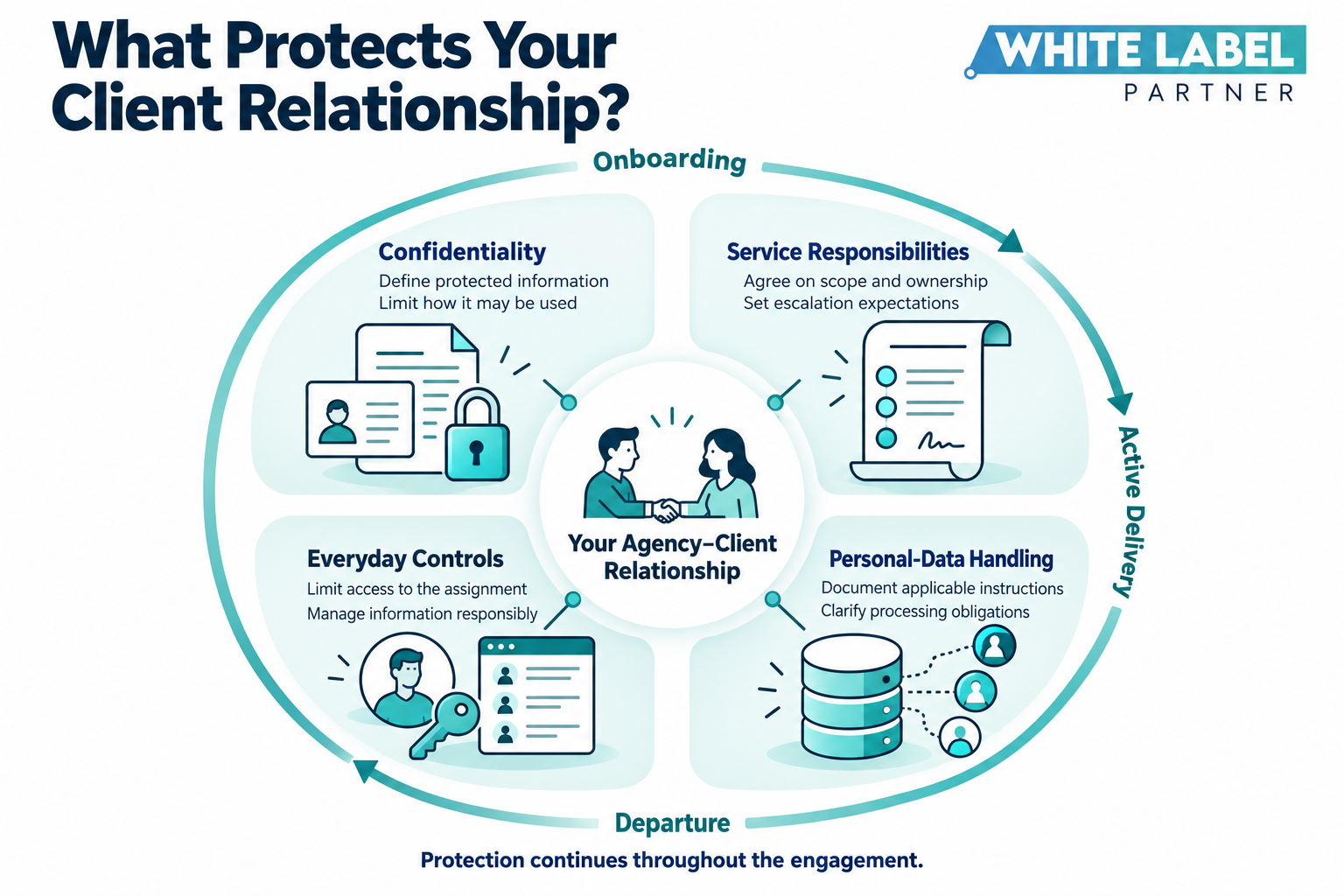
A white label NDA is a confidentiality agreement that defines what information an agency and its delivery partner must protect, who may receive it, and how it may be used. Those distinctions matter: keeping a client’s campaign plans private doesn’t authorize using them elsewhere.
Protecting that trust also means agreeing on account access, data handling, incident communication, and what happens to information after the work ends.
Clear expectations make it easier to bring another team into your delivery process. You can share what the assignment needs, understand who’s responsible, and give collaboration room to develop. Before handing over the first detailed brief, we recommend settling the boundaries that let both teams get on with the work confidently.
Know What You’re Agreeing to Before Work Begins
Before sharing project information, agree on what each party is responsible for. A white label partnership agreement helps establish those expectations, with supporting terms covering the details below.
Confidentiality: Identify the protected information, authorized recipients, and permitted uses. A mutual NDA may suit an arrangement where both parties share confidential material; it isn’t automatically necessary for every engagement.
Service agreement: Define the work, responsibilities, ownership, payment, change approvals, and termination arrangements. Your website privacy policy doesn’t establish these project-specific commitments or settle how client information will be handled.
Service levels: Agree on response expectations, escalation contacts, and any remedies for missed commitments. An acknowledgment confirms that an issue has been received; a resolution commitment addresses when it should be fixed. Make that distinction clear before an urgent request arrives.
Personal-data processing: Agree on what personal information the partner needs, how it may be used, which safeguards apply, and how additional providers and deletion requests will be handled. Where the CCPA applies, California’s service-provider contract requirements set specific obligations. Other state privacy laws and GDPR or UK GDPR for relevant international work may also affect the terms.
These responsibilities can sit within an agreement and its schedules. You don’t automatically need four separate documents, and signing them doesn’t itself establish compliance.
*This article provides general information, not legal advice. Have your lawyer review agreements against your client commitments and applicable law.
Protect the Client Trust You’re Bringing Into the Partnership
Your partner needs enough information to do the job properly. Agreeing on what they can use, who they can involve, and how they represent your agency helps you share that information with confidence. Those boundaries deserve attention before the first detailed brief changes hands.
Name the Information and Limit Its Use
‘Everything is confidential’ leaves too much open to interpretation.
An NDA for marketing agencies should identify the information the assignment involves, including:
- Client identities and contact details.
- Pricing, margins, proposals, and commercial terms.
- Campaign plans, research, unpublished assets, and proprietary processes.
- Credentials and confidential technical information.
Permission to see information isn’t permission to reuse it.
A partner may need campaign research to complete your brief; that doesn’t authorize using it for another agency.
WIPO’s guidance on NDA scope and permitted use reinforces the importance of defining both. Ask your attorney to review the scope, exclusions, authorized recipients, legally required disclosures, duration, and governing law so the terms fit the relationship.
Set the Rules for Client Contact and Publicity
Your client relationship needs clear communication boundaries.
As you assess confidential white label partners, ask how those boundaries apply to everyday interactions:
- Who may contact the client, and with whose approval?
- Can delivery specialists join calls, and how will they be introduced?
- Does using a client’s logo, results, screenshot, or testimonial require written permission?
Doing the work doesn’t automatically grant permission to publicize it.
Separately, discuss restrictions on approaching your clients for additional business. Confidentiality protects information; non-solicitation addresses specified outreach. Your attorney should review any restriction under applicable law.
Keep branding expectations clear while allowing for disclosures required by law or the platforms involved.
Keep the Same Boundaries Around Everyone Involved
Confidentiality arrangements need to account for the people and tools involved in delivery.
Before beginning a white label partnership with NDA, establish:
- Which employees, freelancers, or additional providers may receive information.
- What confidentiality obligations apply to authorized recipients.
- Which subprocessor approvals and equivalent protections are required, where applicable.
- Which tools are approved, including whether confidential material may enter AI services.
Adding a person or platform can change who receives your information.
Agree on who reviews those changes and coordinates any necessary approvals.
At White Label Partner, we’re happy to sign an NDA. Discuss your project-specific requirements with us before exchanging confidential information so expectations are clear from the outset.
Give Your Delivery Team the Access the Work Actually Needs
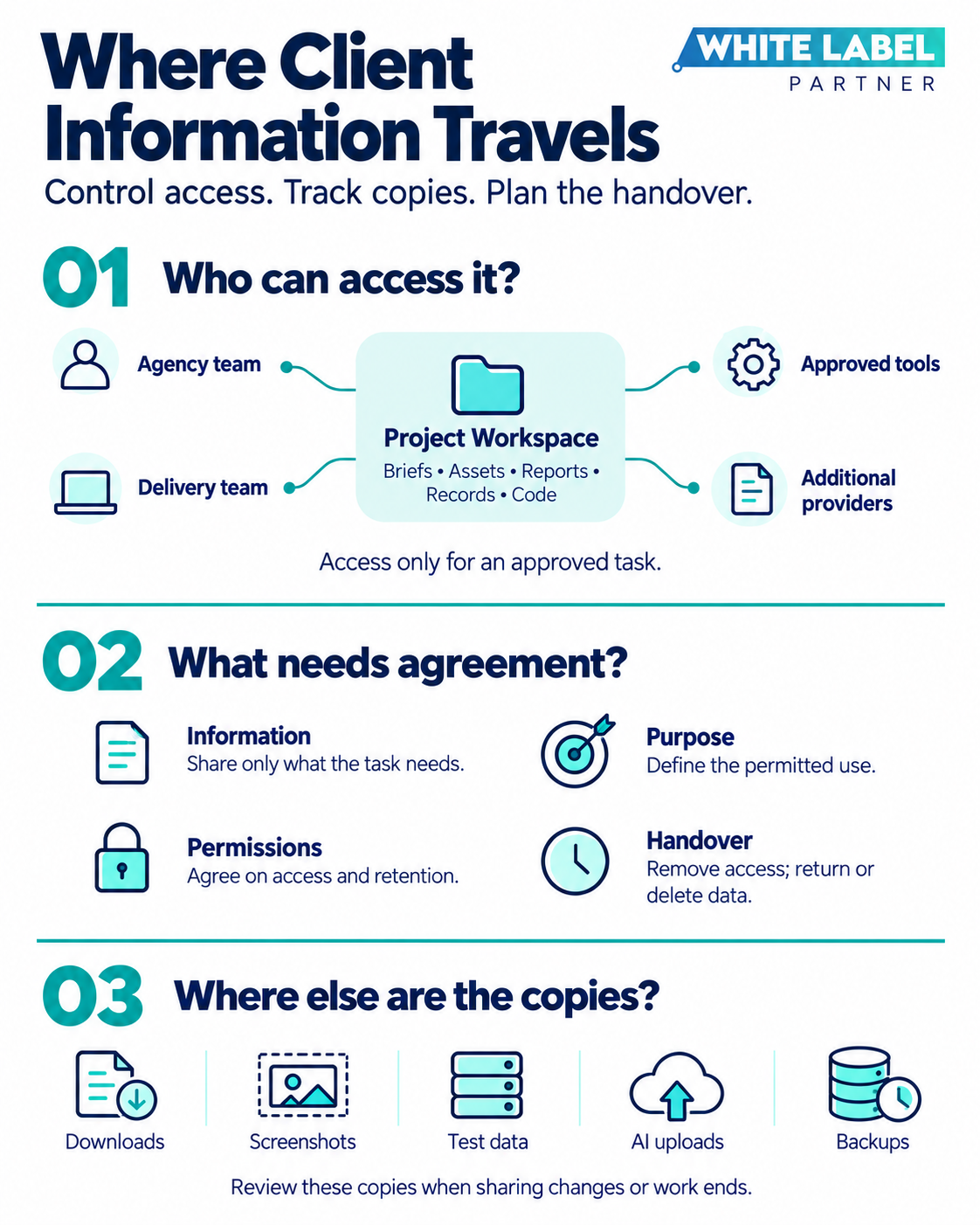
A specialist can’t help without access, but every assignment needs different permissions. Least-privilege access means giving people what their task requires and reviewing those permissions as responsibilities change. The FTC’s guidance on vendor security recommends limiting access to necessary information and the time needed to do the job.
Keep CRM Access Within the Client’s Workspace
During GoHighLevel sub-account setup, discuss who needs access to the client’s workspace and which roles suit their responsibilities. Named users make individual access easier to review and remove.
Check the connections around that workspace, too:
- Can users export contact records?
- Which integrations send information elsewhere?
- Who controls account recovery and administrative permissions?
A separate workspace still needs deliberate permission settings.
Confirm who controls the account, how recovery works, and what happens when someone changes roles. A specialist taking over appointment workflows may need different permissions from someone preparing reports. Review access accordingly, including connected tools and previously downloaded information.
Separate Reporting Work From Administrative Control
An agency commissioning white label SEO services should distinguish reviewing performance from changing the website. Preparing a report may require analytics access; implementing a technical fix may require additional permissions.
Agree on:
- Which systems and permission levels each task requires.
- Who approves changes to the live website.
- When temporary access will be removed.
Keep client account ownership and recovery access documented. An urgent fix shouldn’t leave the agency dependent on one person’s login. At the end of the assignment, review users and connections, then remove access that ongoing work no longer requires.
Give Developers a Suitable Place to Work
Before engaging a white label app development company, establish where development and testing will happen. Separate environments and synthetic or appropriately masked test data can reduce unnecessary exposure.
Discuss repository permissions, secure storage for API keys, and who may deploy changes. Production support may need different access from routine development, with approval and removal arrangements agreed beforehand.
Assess the provider’s practices, evidence, and responsibilities. Geography alone doesn’t establish how securely the work will be handled.
Turn Security Promises Into Answers You Can Assess
A conversation about safeguards becomes useful when you can connect each answer to the proposed work. As you vet a white-label partner, use this checklist to identify what’s documented, what needs clarification, and what should be agreed before access begins.
| Requirement | Why It Matters | What to Ask For |
|---|---|---|
| Confidentiality scope | Protects relevant information and limits its use. | Terms covering client details, commercial information, authorized recipients, and permitted purposes. |
| Additional providers | Identifies who else may handle information. | Relevant providers, approval arrangements, and applicable confidentiality obligations. |
| Account access | Limits unnecessary permissions. | Proposed users and roles, multifactor authentication arrangements, and an access-review process. |
| Information handling | Accounts for copies outside the main workspace. | Approved sharing tools, export restrictions, storage locations, and retention arrangements. |
| Incident communication | Supports a coordinated response. | Named contacts, notification expectations, escalation channels, and an update process. |
| Ownership and departure | Preserves continuity when work ends. | Agreed deliverables, account control, access removal, and return or deletion procedures. |
Ask for evidence that fits the work you’re entrusting to the team.
A limited design assignment and ongoing access to customer records warrant different levels of review. A redacted process document, sample access checklist, or walkthrough may help clarify how the proposed arrangements operate.
Certifications can inform that review, but check which entity, systems, and services they cover. A provider should be able to explain its process without exposing another client’s confidential information.
Know Who Makes the First Call if Something Goes Wrong
An incident is easier to manage when both teams already know how to communicate. Planning for data security in white label partnerships should establish who raises concerns, what they share, and how the agency stays informed.
➢ Raise the alert.
Name a primary contact, a backup, and an escalation channel for urgent issues. Agree on notification triggers and timing. An acknowledgment confirms receipt; it doesn’t mean the incident has been contained or resolved.
➢ Establish the facts.
Identify the systems involved, information potentially affected, containment measures taken, and evidence preserved. Separate confirmed findings from unanswered questions. Don’t delay a required initial notification while waiting for a complete investigation.
➢ Coordinate the response.
Set expectations for continuing updates and assign responsibility for client communications and any legally required notices. Investigation explains what happened; containment limits further harm; resolution addresses the underlying issue. Each needs its own follow-through.
The FTC’s breach-response guidance recommends preserving evidence, preparing a communications plan, and checking applicable notification requirements.
There’s no universal 72-hour allowance for notifying an agency.
Contractual expectations and legal deadlines need separate consideration. Agree on communication responsibilities early, while recognizing that approval arrangements can’t override legal duties.
Keep Your Client’s Work Moving After the Engagement Ends
A project can finish successfully and still leave loose ends. Agreeing on the handover early helps your agency keep serving the client without chasing files, recovering accounts, or wondering who still has access.
Return the Work and Remove the Access
A white label NDA addresses confidentiality; it doesn’t automatically determine ownership of newly created work. Address ownership and usage rights in the appropriate agreement, distinguishing project deliverables from pre-existing materials and third-party licenses.
Build the handover around:
- Source files, repositories, documentation, and the status of outstanding work.
- Account ownership, administrative permissions, and recovery methods.
- Removal of departing users, access tokens, and unnecessary integrations.
- Rotation of shared passwords, API keys, or other secrets where appropriate.
Assign responsibility and deadlines so access changes support an orderly transition.
Account for the Copies That Remain
Agree on what information will be returned or deleted, when that happens, and what written confirmation will follow. Identify any information that must be retained for legal or other valid obligations, with appropriate limits on access and use.
Backups may follow a defined deletion cycle rather than disappear immediately. Document that cycle and the safeguards around retained copies. Specify which confidentiality obligations continue after termination.
Related reading: How White Label Agency Partners Help Digital Agencies Scale
Your Next Partnership Deserves a Clear Beginning
You may already have a white label NDA ready for review, client restrictions to work through, or questions about account access. Those are useful starting points for a conversation about how we can support your agency.
Share the service you’re considering, the systems involved, and the confidentiality requirements that matter to your client. We can discuss the scope and identify what needs agreement before sensitive information changes hands. We’re happy to sign an NDA, and dedicated project management gives your agency a consistent point of coordination.
At White Label Partner, we welcome those questions. To schedule a meeting, contact us and suggest a convenient time. We’ll discuss delivery arrangements while your counsel reviews the legal terms.
Frequently Asked Questions
These answers cover early confidentiality discussions. Our agency partnership FAQs explain more about working with us.