
White Label Reseller Programs Explained: How Agencies Resell Digital Marketing Under Their Brand
Saying “Of course! Yes, we can do that!” feels pretty good. It’s how agencies win larger accounts and become the team a client calls first.
Although, the satisfying part lasts longer when you know what that yes will cost, who’ll deliver it, and what you’re putting your name on.
For an agency, becoming a digital marketing white label reseller means selling an agreed service under your own brand while a partner completes the assigned work behind the scenes. You decide what goes into the offer, set the client price, and lead the relationship. The partner gives you the delivery capacity to make it happen.
A logo on a report helps, but the real test is whether the scope, work, and client experience hold together as one service. So, how do you turn a promising request into an offer you’re happy to sell again?
We’ll look at the different kinds of reseller programs, the choice between reselling and referring, and the practical work of packaging, pricing, and agreeing on terms before a client signs.
First, Know What Kind of Program You’re Joining
Reseller can describe two quite different offers.
| In a Software Reseller Setup… | But a Service Reseller Setup… |
|---|---|
| Your agency sells access to a platform under its brand, often adding configuration, training, or support. HighLevel’s SaaS mode is one example: agencies can brand and resell the platform to their clients. | Provides the people to do the work. A partner completes the SEO, paid ads, website development, or other tasks your agency has scoped and sold. Your team presents the service and remains accountable for the client experience. |
In Both Cases…
| What’s Included? | Software | Services | Both |
|---|---|---|---|
| What the client buys | Platform access | Agreed work and deliverables | Access plus managed work |
| What your agency must arrange | Setup and support | Scope, review, and client communication | Clear ownership of each part |
A white label reseller program can combine these models. A branded dashboard may give your client a place to see activity; someone still needs to plan the campaign, do the work, and explain the results. Start by asking what the proposed fee covers: access, delivery, or both.
Explore the available white label agency services.
For the fundamentals, read what is white labeling; our white label digital marketing guide covers the broader agency model.
Will You Be Selling the Service or Refer the Client?
A client opportunity can take your agency in two directions. You might turn it into a service of your own, with a partner delivering behind the scenes.
Or you might introduce the client to a provider and leave the service management to them. The choice depends on the role you want after the introduction.
In a digital marketing reseller program, your agency builds the offer, sets the client fee, and remains their point of contact. You gather requirements, coordinate approvals, and present the work your partner completes. Your earnings depend on the client price, the partner’s quote, and the time your own team puts in.
With a referral, the provider becomes client-facing and handles delivery. Under our referral model, you earn a commission on successful payments from the clients you introduce.
| You Resell | You Refer | |
|---|---|---|
| Client relationship | Your agency leads it | The provider leads it |
| Client pricing | Your agency sets it | The provider sets it |
| Your role after the sale | Manage the offer and client communication | Make the introduction |
| How you earn | From the fee your agency charges | An agreed referral commission |
Our reseller and referral partnership models give you room to make that choice service by service. If you want to build an offer under your brand, reselling is the path to explore.
If you’d rather connect a client with help your team won’t manage, a referral may fit. See how to become a partner.
Turn Capabilities Into an Offer a Client Can Buy
Your client has a business need, not a shopping list of marketing services. Start with the outcome they want, then build the smallest package that can reasonably support it. The proposal should tell them what work is included, what your team needs from them, how progress will be reported, and where the agreed scope ends.
Give Each Promise a Clear Scope
An SEO reseller program might support a monthly plan built around research, agreed technical and content tasks, and a reporting schedule.
Paid ads and websites need different boundaries:
| Offer | Specify in the Proposal | Price Separately if Needed |
|---|---|---|
| SEO retainer | Priority pages, planned work, and reporting cadence | Additional content or a site migration |
| PPC management | Campaign setup, optimization, and review dates | Ad spend, new creative, or landing pages |
| Website project | Pages, functionality, copy ownership, and approval rounds | Extra pages or integrations |
The distinction is especially useful for white label GoHighLevel services. Are you selling platform access, initial setup, automations, ongoing management, or a combination? Name each part so your client knows what their fee includes and your delivery partner knows what to produce.
You can bring services together around one outcome. A lead generation offer, for instance, could pair a landing page with paid ads. Give each component its own scope and price assumptions so a request for another page or campaign is easy to discuss.
Explore our SEO reseller services, white label PPC management, and white label website design as you shape the offer.
Put a Price on the Promise
The partner’s quote gives you a starting cost. Your client fee has a bigger job: it must cover that delivery, the time your agency spends shaping and managing the offer, and room for the business to earn from it. Price the service your client actually receives, including your strategy, communication, review, and accountability.
See Where the Client Fee Goes
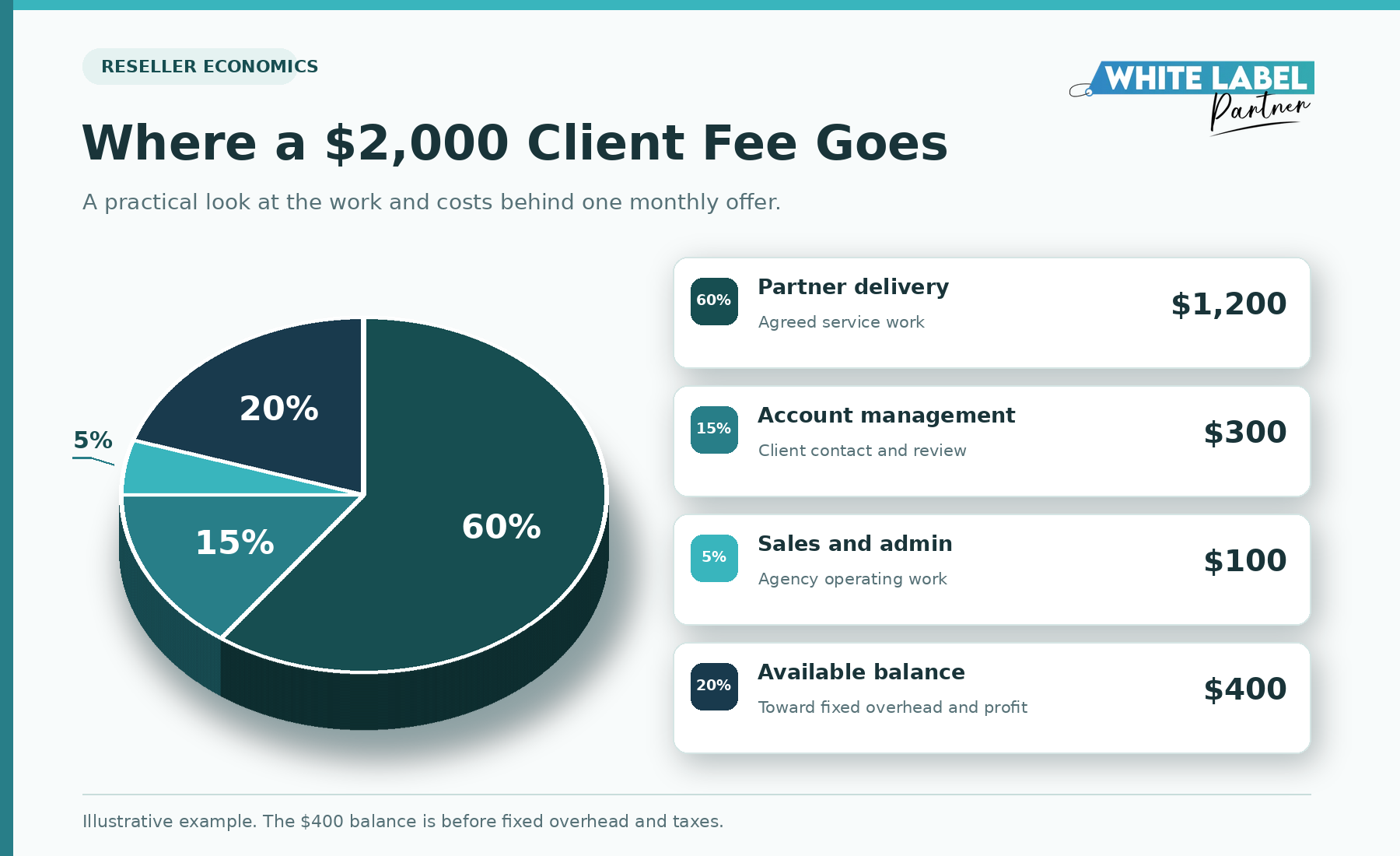
Say your agency charges $2,000 a month for an agreed marketing package. The partner’s delivery price is $1,200. Your team budgets $300 for account management and review, plus $100 for sales and administration. That leaves $400 toward fixed overhead and profit.
The difference between your client fee and the partner price is $800.
That’s a 66.7% markup on the $1,200 partner cost.
Expressed as a share of the $2,000 client fee, it’s 40% before your agency’s own costs.
Those percentages answer different questions: markup compares your selling price with your partner cost; gross margin after partner cost shows how much of the client fee remains at that stage.
For a digital marketing white label reseller, a useful price starts with a clear scope and the work both teams will contribute. Promethean Research’s 2026 Digital Agency Industry Report finds that agencies commonly combine pricing methods, including fixed bids and retainers. The right structure depends on what your client is buying: a defined project, ongoing work, or a package with elements of both.
The ROI of reselling becomes easier to judge when you can see what each offer earns and what it takes to deliver. Explore how we support a digital marketing reseller, or read more about the ROI of scale.
Why Settle the Terms Before the First Invoice?
A clear client offer needs an equally clear understanding between your agency and the team delivering it. You should both be able to answer the practical questions before work begins, including what happens if the client asks for something extra.
Four Details to Put in Writing
A white label partnership agreement can be a written record of what you’ve decided for this scope. Make sure it covers:
- Scope and price: What’s included in the partner’s quote? What’s excluded? Who quotes additional work, and who approves a revised price?
- Billing: Who invoices the client, who invoices your agency, and when are payments due? Identify any ad spend or software charges billed separately.
- Brand and access: Which deliverables arrive without partner branding? Set permissions for accounts, use of logos, confidentiality, and ownership of finished assets.
- Service expectations: Agree on review dates, response times, reporting cadence, and how both teams will handle a change in priorities.
These details make the offer easier to manage as a business relationship. Your agency can price and explain the service with confidence, while the delivery team knows what it has committed to produce.
If the client requests another landing page or a new campaign, you already have a way to assess it together.
For more on the decision before you start, see how to choose the right reseller partner and ways to develop a successful white-label partnership.
Give the Client One Clear Agency Experience
Your client should know who to come to for an answer. Your agency explains the offer, gathers the information needed to begin, makes decisions about priorities, and presents the work. A delivery partner contributes expertise behind the scenes; the service still needs to sound and feel like the one your agency sold.
At White Label Partner, we work on the scope agreed with your agency and provide the work and updates your team needs to review. You decide what’s ready to share and how to explain it in the context of the client’s goals.
Make the Report Worth Opening
Take an SEO retainer.
A partner may provide details on technical fixes, published pages, search visibility, and enquiries.
Your agency can turn those details into a client-facing account of what changed, what the results suggest, and what deserves attention next. Branded reporting earns its place when it helps the client understand the work, not just recognize the logo.
That clarity matters.
In the 2026 Marketing Agency Benchmarks Report, 55% of surveyed agency professionals said the question they heard most from clients was whether marketing performance could be connected to revenue. Explain the connection your data supports, without promising one the tracking can’t show.
Clear communication is among the benefits for your clients.
Also read: What white label fulfillment involves behind the agency’s offer.
Proceed With An Offer You’d Be Happy to Put Your Name On
You don’t need a complete new service menu for the first partner conversation. Bring one client need you understand and an offer you’d consider putting in a proposal.
Make the First Package Specific
Describe the outcome, included work, client inputs, and reporting you expect. Ask the partner to quote that scope, then review a sample deliverable or report. Add the time your agency will spend on strategy, communication, and approvals before setting the client price. You’ll have a much clearer offer to discuss than ‘we might need some SEO support’.
Ask for Proof You Can Sell It
- Can you deliver this scope, and what do you need from us to begin?
- What will our agency receive to review before the client sees it?
- Who handles questions during delivery?
- How would an added request change the price or timeline?
A white label digital agency should be able to work through those questions with you; explore our approach as you compare options. Agree on who signs off the work, then you can take the offer into a client conversation with a price and delivery plan behind it.
For broader ideas, read about white label marketing solutions for growing agencies.
Build Your Next Offer With a Reliable Delivery Partner
Bring us one service idea or a draft client scope. At White Label Partner, we can talk through the delivery work, the partner quote, what your team will manage, and what you’ll need for a client-ready offer.
If you’re considering becoming a digital marketing white label reseller, a conversation can help turn that first idea into a package you can price and present with confidence. Explore how to become a partner and book a meeting, or call +1 980-390-2338.
Let’s find a starting point that works for your agency.
Frequently Asked Questions